Most independent restaurants are paying for more software than they realize - and much of it isn’t producing measurable return.
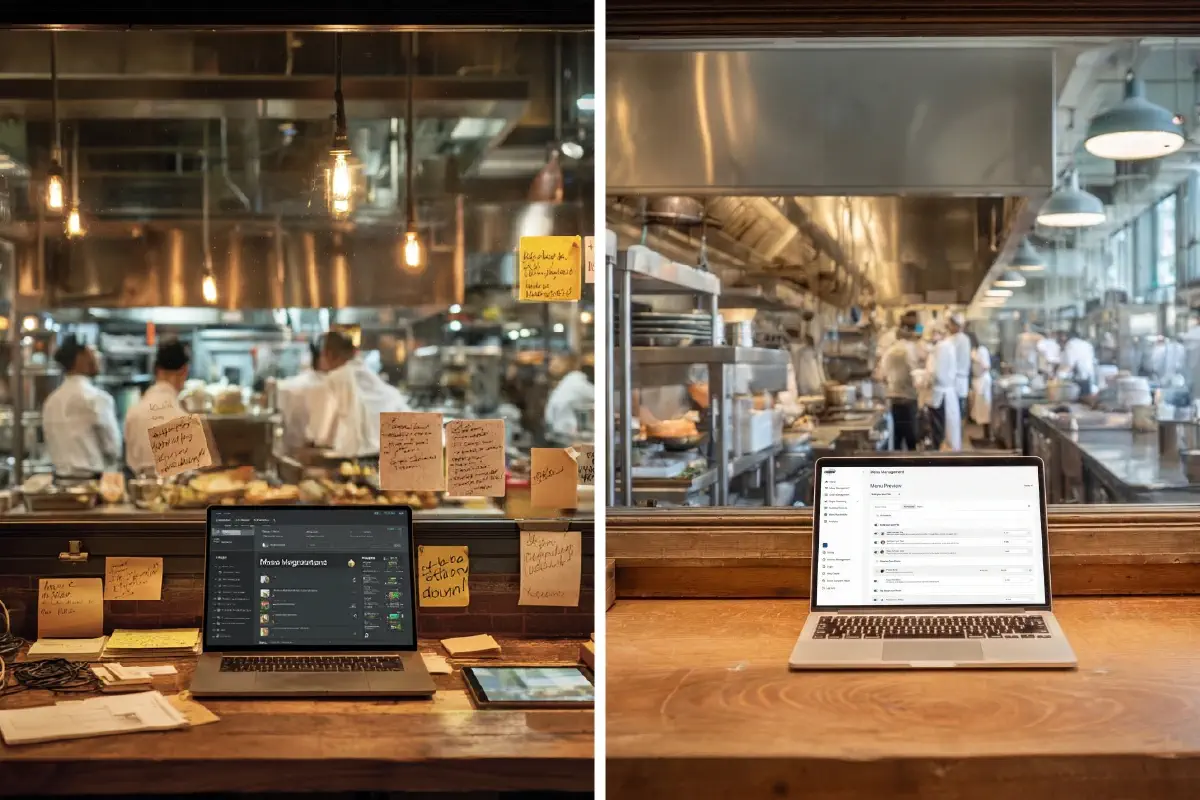
The average independent restaurant in 2026 runs five to eight separate tools: a POS system, an online ordering widget, a delivery tablet (or multiple), a loyalty app, some kind of email marketing thing you set up once and forgot about, and a reporting dashboard you never log into.
Add it up. That's $800 to $2,000 a month in subscriptions - before you count the labor hours spent keeping all of it running. Menu changes alone eat 3-5 hours a week when you're updating six different platforms one at a time.
Here's the question nobody's asking: What's the return on all that software?
Not "does it have good features." Not "is it industry-leading." Does it put more money in your pocket than it takes out?
This guide breaks down the restaurant tech stack that actually pays for itself within 90 days. Not theory - dollar math. We'll walk through every category using two real examples: a pizza shop doing $40K/month and a taco shop doing $25K/month.
Before we talk about what works, let's talk about what's bleeding you dry.
Most restaurant owners don't realize how much their disconnected software costs because the expenses are spread across a dozen line items. When you pull them together, the picture gets ugly fast.
| Tool | Typical Monthly Cost |
|---|---|
| POS system | $70–$150 |
| Online ordering platform | $100–$300 |
| Delivery integration/tablets | $50–$200 |
| Email marketing tool | $30–$100 |
| Loyalty program | $50–$150 |
| Website builder/hosting | $30–$80 |
| Review management | $50–$100 |
| Analytics/reporting | $50–$150 |
| Total | $430–$1,230/month |
That's $5,160 to $14,760 per year - just in subscription fees. For a taco shop doing $25K/month, that's up to 5% of gross revenue going to software before you serve a single customer.
But the subscription cost is the small part. The real damage is hidden.
Manual order re-entry: When delivery orders come in on a tablet and your staff has to type them into the POS, you're burning 2-4 hours per week in labor and introducing errors on an estimated 5–10% of third-party orders, based on common operator reports. At a pizza shop doing $40K/month, order errors cost $400-$800/month in remakes, refunds, and lost customers.
Menu update lag: Change a price or 86 an item? If you're managing menus across multiple platforms separately, that update takes 30-60 minutes across all channels. During that lag, you're selling items you don't have or losing margin on mispriced ones.
Data blindness: When your ordering data lives in one system, your marketing data lives in another, and your financials live in a third, you can't answer basic questions. Which menu items drive repeat orders? Which marketing campaigns actually produced revenue? You're guessing - and guessing costs money.
If any of this sounds familiar, you're not alone. These are the exact signs that your restaurant software stack is too complicated.
Here's how to evaluate every piece of your restaurant tech stack through one filter: Will this pay for itself in 90 days?
If the answer is no, it doesn't belong in your stack.
Let's walk through each category with real dollar math for our two example restaurants.
What it does: Connects every order source - first-party website, delivery apps, Google - directly into your existing POS. No tablets. No re-entry. One ticket printer, one kitchen workflow.
The 90-day math for a pizza shop ($40K/month):
• Order errors eliminated: ~$600/month saved (remakes + refunds)
• Labor saved on manual entry (2-4 hrs/week at $18/hr): ~$216/month
• Improved ticket flow during peak periods can reduce bottlenecks, potentially recovering ~$200/month in additional throughput
• 90-day ROI: ~$3,048 saved
The 90-day math for a taco shop ($25K/month):
• Order errors eliminated: ~$375/month
• Labor saved on manual entry: ~$180/month
• Faster ticket flow: ~$125/month
• 90-day ROI: ~$2,040 saved
POS integration isn't a feature. It's the plumbing. Everything else breaks without it. Chowly connects with Toast, Square, and 50+ POS systems so orders flow in automatically - same ticket, same printer, same workflow your team already knows.
What it does: Complement third-party ordering with a branded first-party ordering experience on your own website and Google profile and keep more per order.
This is where the biggest money lives.
The 90-day math for a pizza shop ($40K/month):
Let's say 30% of revenue comes through delivery apps. That's $12,000/month, with $2,400-$3,600 going to commissions.
Shift just 25% of those orders to first-party (commission-free) in 90 days:
• Commission savings: $600-$900/month × 3 = $1,800-$2,700
• Higher average ticket (first-party orders are typically 15-20% larger): ~$450 additional revenue over 90 days
• 90-day ROI: $2,250-$3,150
The 90-day math for a taco shop ($25K/month):
Same ratio - 30% through delivery apps = $7,500/month, with $1,500-$2,250 in commissions.
Shift 25% to first-party:
• Commission savings: $375-$562/month × 3 = $1,125-$1,686
• Higher average ticket: ~$280 over 90 days
• 90-day ROI: $1,405-$1,966
These aren't hypothetical numbers. Taqueria El Tapatio in Santa Clarita, CA - a real taco restaurant - saw a 256% increase in integrated online-order revenue and a 711% increase in online orders after consolidating onto one platform. They had no website and no first-party ordering before. Now their digital storefront drives revenue they actually keep.
What it does: Automated email campaigns, SMS, and targeted promotions that trigger based on customer behavior - not your memory. Welcome series for new customers, win-back campaigns for lapsed ones, birthday promos, reorder reminders.
The 90-day math for a pizza shop ($40K/month):
• Industry benchmarks show automated retention campaigns can increase repeat purchase rates by 10–25% when implemented consistently
• New repeat orders from automated campaigns: ~$1,200-$2,000/month
• Labor saved vs. manual marketing (2-3 hrs/week): ~$162/month
• 90-day ROI: $4,086-$6,486
The 90-day math for a taco shop ($25K/month):
• New repeat orders from automation: ~$750-$1,250/month
• Labor saved: ~$162/month
• 90-day ROI: $2,736-$4,236
The key here is automation. You're not writing emails every Tuesday. The system triggers campaigns based on real behavior: someone orders once and gets a follow-up three days later. Someone hasn't ordered in 30 days and gets a win-back offer. This runs in the background while you run your kitchen.
That's the kind of restaurant automation that saves 20+ hours per week - and actually drives measurable revenue.
What it does: Points-based loyalty that works across channels - earn online, redeem in-store, and vice versa. Two-way sync with your POS so there's no manual tracking.
The 90-day math for a pizza shop ($40K/month):
• Loyalty members order 2-3x more frequently than non-members
• 10% of customers enrolled in first 90 days = ~200 loyalty members
• Incremental revenue from increased frequency: ~$800-$1,200/month
• 90-day ROI: $2,400-$3,600
The 90-day math for a taco shop ($25K/month):
• 10% enrollment = ~120 loyalty members
• Incremental revenue: ~$500-$750/month
• 90-day ROI: $1,500-$2,250
The critical piece most loyalty programs miss: two-way POS sync. If a customer earns points ordering online but can't redeem them in-store - or vice versa - the program feels broken and they stop engaging. Unified loyalty that works everywhere is a requirement, not a nice-to-have.
What it does: Revenue tracked by source - first-party vs. third-party, channel by channel, menu item by menu item. Not five dashboards. One view.
The 90-day math (both restaurants):
This one's harder to assign a direct dollar figure because analytics is a multiplier. It makes every other decision better.
But here's what it enables:
• Identify your top 5 most profitable items and promote them (menu engineering)
• See which marketing campaigns actually drove orders (not vanity metrics)
• Spot when third-party commission rates change before they crush your margin
• Know exactly which channel to invest in next
Operators who track revenue by source report stronger visibility into margin performance and channel effectiveness. The insight that "our Google orders have 40% higher average ticket than delivery app orders" changes where you spend your next marketing dollar.
Here's the argument that stops most restaurant owners in their tracks:
"I can't afford another subscription."
You're right - if you're adding another tool on top of six existing ones. But what if you're replacing five of them with one platform?
| Tool | Monthly Cost |
|---|---|
| Online ordering | $150 |
| Email marketing | $60 |
| Loyalty | $100 |
| Website builder | $50 |
| Review management | $75 |
| Delivery integration | $100 |
| Analytics dashboard | $75 |
| Total: 7 tools | $610/month |
| Platform | Monthly Cost |
|---|---|
| Chowly (online ordering, marketing, loyalty, website, delivery integration, analytics) | Varies by plan |
Plus: One login. One support team. One menu to update. One dashboard.
Liv's Juice Bar saved $121,000 per year after consolidating their tech stack - that's not just subscription savings, that's the full picture including labor, commission reduction, and operational efficiency.
The real question isn't whether consolidation costs money - it's whether maintaining a fragmented stack is costing you more.
If you're spending more than 4-5 hours per week managing your software stack, you're losing over 100 hours per year that could go toward running your restaurant.
The restaurant tech stack in 2026 isn't about having the most tools. It's about having the fewest tools that cover the most ground - and actually produce revenue.
Here's the stack that pays for itself:
• POS system - Your operational backbone (Toast, Square, or similar)
• Unified platform - Online ordering + delivery integration + marketing + loyalty + website + analytics in one place
Everything else should be evaluated against one standard: does it produce measurable revenue or operational efficiency?
• Commission-free online ordering through your branded website and Google
• Delivery app integration routed directly into your POS
• Automated marketing - email, SMS, targeted campaigns
• Two-way loyalty - earn and redeem across all channels
• AI dynamic pricing - automatically adjust third-party prices to recover commission costs
• AI dispute management - chargebacks handled automatically
• Website and Google Business Profile - one source of truth for your digital presence
• Revenue analytics - tracked by source, not guesswork
This is what AI that actually works for restaurants looks like in practice - not gimmicky chatbots, but AI applied to pricing, marketing, and operations where it moves the needle on profit.
| Component | Tool | Why |
|---|---|---|
| POS | Toast/Square | Existing operational backbone |
| Everything else | Chowly Platform | Online ordering, delivery integration, marketing, loyalty, website, analytics, AI pricing |
Estimated 90-day ROI across all categories: $11,784-$16,284
That's money back in your pocket - not a projection, but the sum of commission savings, error reduction, labor recovery, and incremental revenue from marketing and loyalty.
| Component | Tool | Why |
|---|---|---|
| POS | Toast/Square | Existing operational backbone |
| Everything else | Chowly Platform | Same unified stack, scaled to volume |
Estimated 90-day ROI across all categories: $7,681-$10,492
Smaller restaurant, same principle. The ROI scales with your revenue - it doesn't require high volume to work.
Theory is nice. Here's what actually happened.
A taco restaurant with no website and no first-party ordering. All digital orders came through delivery apps with full commission exposure.
After launching on the Chowly Platform:
• 256% increase in integrated online-order revenue
• 711% increase in online orders
• 5x increase in website traffic
The shift came from doing exactly what this article describes: consolidating delivery, launching first-party ordering, and routing all demand through one system.
Nora was getting orders, but most came through third-party channels. After switching to a unified platform:
• First-party orders grew from 52.6% to 83.8% of total online orders
• 34% increase in total online orders
That's not just more orders - it's more profitable orders because they're commission-free.
Running a patchwork of disconnected tools across ordering, marketing, and operations:
• $121,000 saved per year after consolidating onto one platform
• 21.4x ROAS on marketing spend
$121K/year isn't a rounding error. That's real take-home money that was previously evaporating across subscriptions, commissions, manual labor, and order errors.
You don't have to flip everything at once. Here's the practical sequence:
• Connect POS integration (orders flow automatically, no more tablet re-entry)
• Launch branded website with online ordering
• Set up Google Business Profile ordering link
Immediate impact: Order errors drop. Manual labor drops. First-party orders start coming in.
• Activate automated email marketing (welcome series, win-back campaigns)
• Launch loyalty program with two-way POS sync
• Enable AI dynamic pricing on third-party channels (recover commission costs)
Growing impact: Repeat customers increase. Third-party orders become more profitable through price optimization. Loyalty members start ordering more frequently.
• Review analytics: which channels drive the most profitable orders?
• Double down on what's working (more marketing spend on high-ROAS channels)
• Shift more volume to first-party through targeted promotions
Compounding impact: First-party order percentage climbs. Customer data grows. Marketing gets smarter with more data. Revenue compounds.
By day 90, you have a clear picture of exactly what your tech stack is producing - in dollars, not dashboards.
• The average restaurant spends $430-$1,230/month on disconnected software - most of which doesn't produce measurable revenue.
• In restaurants at this volume, POS integration commonly prevents $2,000–$3,000 in avoidable errors and labor inefficiencies within the first 90 days.
• Shifting 25% of third-party orders to first-party saves $1,400-$3,150 in 90 days through commission elimination.
• Automated marketing and loyalty programs generate $4,000-$10,000+ in 90-day incremental revenue without requiring manual effort.
• Consolidating 5-8 tools into one platform reduces subscription costs, simplifies operations, and produces better results. Liv's Juice Bar saved $121K/year.
• The ideal 2026 restaurant tech stack is two layers: your POS + a unified platform that handles everything else.
• The question isn't "can I afford new software?" - it's "can I afford to keep paying for software that doesn't pay me back?"
Get a demo and we'll walk through your numbers - what you're spending now, what you'd save, and what 90 days on the Chowly Platform looks like for your operation.
The cost depends on your current stack and the platform you consolidate onto. Most restaurants spending $500-$1,200/month across 5-8 tools find that a unified platform like Chowly costs less than their current total - while producing significantly more revenue through first-party ordering, marketing automation, and loyalty. For many operators, subscription savings and commission reduction significantly offset platform costs - often within the first billing cycle.
No. Modern platforms integrate with your existing POS - Toast, Square, and 50+ others - so your kitchen workflow doesn't change. Orders still print on the same printer, in the same format. The transition typically takes 1-2 weeks for full setup, and most restaurants see immediate improvements in order accuracy and staff workload.
Run the math anyway. If your consolidated platform saves $1,000+/month in commissions, labor, and subscriptions, early termination fees on a $100/month tool pay for themselves in weeks. Most operators find the financial case for switching is overwhelming once they see the full picture.
No. The taco shop example in this article does $25K/month - that's a small independent restaurant. The ROI math scales proportionally. Even at $15K/month, the commission savings alone from shifting orders to first-party typically cover the cost of a unified platform.
Track three numbers monthly: (1) commission dollars saved by shifting orders to first-party, (2) labor hours recovered from automation, and (3) incremental revenue from marketing and loyalty programs. A good platform gives you these numbers in one dashboard without manual calculation.