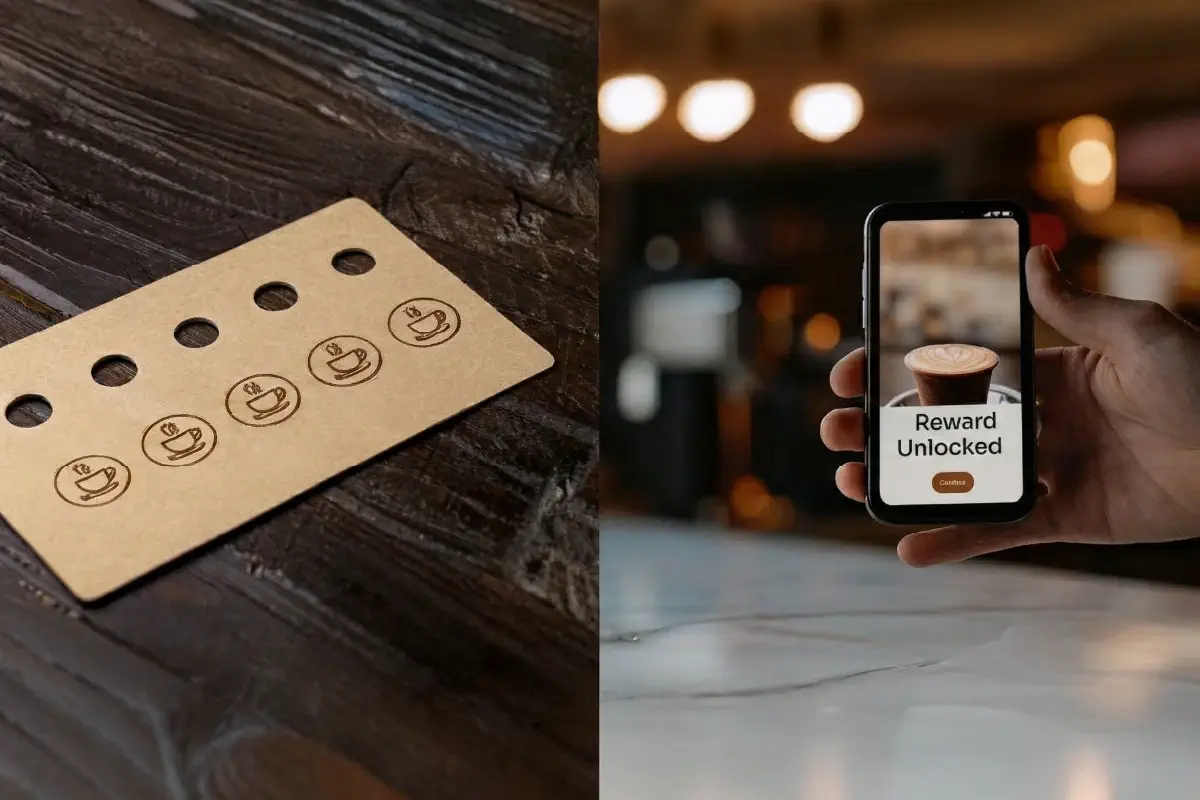
Your regulars are your most profitable customers. A loyalty program turns occasional visitors into regulars - and regulars into your best salespeople. This guide covers everything independent restaurant operators need to know about building a loyalty program that actually moves the needle on repeat revenue.
Restaurant marketing in 2026 comes down to one shift: owning the relationship with your customers instead of renting it from third-party delivery apps. Here's what that looks like in practice:
• Digital loyalty programs generate roughly 3× more profit per enrolled guest than physical punch cards by lifting visit frequency, average order value, and retention at the same time.
• Loyalty members spend 67% more than first-time customers and visit up to 2× more frequently.
• First-party loyalty is the key: when rewards are tied to your own ordering channels, every repeat visit builds equity you own - not margin you're renting from third-party delivery apps.
• Two-way loyalty (earn online, redeem in-store) is the new standard for independent restaurants. It requires POS integration that most platforms can't deliver.
• Two Eggs! saw a 53% increase in first-party online sales after unifying digital loyalty with their ordering. Nora Restaurant & Bar grew first-party orders from 52.6% to 83.8% of total online sales.
• The biggest mistake isn't skipping loyalty - it's running a program that can't connect to your ordering or POS data, which means you're giving away rewards without tracking whether they're driving revenue.
Restaurant loyalty programs have moved from "nice to have" to "need to have." The math is simple: acquiring a new customer costs five to seven times more than keeping an existing one, and loyal guests spend 67% more per order than someone walking in for the first time.
The industry data backs this up. In the United States, 41% of consumers say loyalty programs influence their restaurant purchasing decisions, and 49% report spending more after joining one. Starbucks attributes over 40% of total revenue to Rewards members. Chipotle credits roughly 30% of daily sales - more than $2 billion in digital revenue - to its loyalty program.
Those are chain numbers, but the principle scales down to every independent restaurant. If you're running a 2- or 3-location operation and half your revenue is going through third-party delivery apps, a loyalty program tied to your own ordering channels is one of the fastest ways to flip that ratio.
The economic pressure makes this even more urgent. With persistent inflation and customers trading down - reducing items per order or hunting for deals before switching restaurants entirely - retention is the most cost-effective growth lever available. A loyalty program doesn't just bring people back. It gives them a reason to spend with you instead of defaulting to the cheapest option on a third-party delivery app.
The question isn't whether loyalty matters. It's whether your loyalty program actually tracks results or just hands out free stuff and hopes for the best.
For a deeper look at how the ordering landscape is shifting toward first-party channels, see the Ultimate Guide to Restaurant Online Ordering.
Not all loyalty programs are created equal. Before you set one up, you need to understand the models that exist, what they cost, and what kind of results they actually produce.
The most common model. Customers earn points on every dollar spent and redeem them for rewards - free items, discounts, or exclusive perks. Points-based programs work because the math is visible: customers can see their progress, which triggers the psychological "endowed progress effect" that keeps them coming back.
Best for: Restaurants with moderate-to-high visit frequency (fast casual, pizza, breakfast spots, coffee shops).
Customers unlock escalating benefits as they spend more. Think Bronze, Silver, Gold - or whatever naming fits your brand. Tiered programs tap into status motivation. Research shows 50% of customers actively change their behavior to reach higher tiers, and top-tier members spend up to 73% more per order.
Best for: Restaurants with a wide spend range and customers who visit at different frequencies.
A flat monthly fee gives members recurring perks - free delivery, a monthly free item, or percentage discounts on every order. Subscription models create predictable revenue and strong habit loops. The upfront commitment means customers feel invested from day one.
Best for: Restaurants with strong delivery/takeout volume or a highly engaged local customer base.
The original loyalty program. Buy 10, get 1 free. Punch cards are easy to understand and cost almost nothing to set up. But they have serious limitations: no data, no spend tracking, no personalization, and up to 45% of cards go unredeemed because customers lose them.
Best for: Very low-tech operations or hyperlocal spots where simplicity is the priority and measurement isn't.
For independent restaurants focused on growing repeat revenue, a points-based program integrated with your POS and online ordering is the highest-performing model. It gives you real data, automatic tracking, and the ability to reward customers based on what they actually spend - not just how many times they show up. For a deeper dive into the psychology behind why these programs work, read 7 Psychological Triggers That Keep Customers Coming Back.
This isn't a philosophical debate - the numbers are stark. Digital loyalty programs outperform physical punch cards across every profitability metric that matters.
| Metric | Physical Punch Cards | Digital Loyalty Programs |
|---|---|---|
| Profitability Impact | Baseline repeat visits | ~3× higher profit per enrolled guest |
| Average Order Value | No measurable lift | +23% AOV; top-tier members +73% |
| Visit Frequency | Encourages occasional returns | 2× more visits; VIP members 3.6× |
| Customer Data | None | Full behavior, spend, and frequency tracking |
| POS Integration | None | Native POS + payments + online ordering |
| Personalization | Impossible | Targeted offers and segmentation |
| Redemption Rate | Up to 45% unredeemed (lost cards) | Near-100% visibility via apps and accounts |
| Gamification | None | +22% retention with tier mechanics |
| Staff Effort | Manual stamping every transaction | Automated at checkout - zero lift |
The ~3× profitability advantage of digital loyalty comes from compounding, not just stacking. Physical punch cards affect one variable - visit frequency - and even then, inconsistently. Digital programs move three variables at once:
Profitability per guest = Visit Frequency × Average Order Value × Retention Duration
• Higher spend per order: Loyalty members spend 12–18% more per visit, with digital users averaging 23% higher AOV.
• More frequent visits: Members visit 22% more often on average. VIP-tier members purchase 3.6× more frequently. Nearly 47% use their loyalty program multiple times per month.
• Longer retention: Digital loyalty enables instant reward redemption, which increases perceived value. 82% of customers say app-exclusive deals keep them engaged longer.
• Behavioral reinforcement through gamification: Gamified loyalty increases retention by 22%. Half of enrolled customers change their ordering behavior to reach higher reward tiers.
When these four effects compound, you don't just get slightly better results - you get a fundamentally different profitability profile.
For more on how these mechanics translate to actual revenue, see How Restaurant Loyalty Programs Drive Repeat Revenue.
Here's the part most loyalty conversations miss: where your customers earn and redeem rewards matters as much as the program itself.
If your loyalty program lives on a third-party delivery app, you don't own the customer relationship. You don't get their email. You don't see their order history. And you're paying 20–30% commission on every "loyal" repeat order. That's not loyalty - that's renting someone else's customers at full price.
When loyalty is tied to your own ordering channels - your website, your app, your in-store POS - every repeat visit builds an asset you own. You keep the customer data. You control the pricing. You can measure exactly how loyalty drives profitability.
The industry is already moving this direction. According to industry data, 40% of limited-service brands report first-party digital ordering as their top growth driver, while only 13% of guests still prefer ordering through third-party apps.
| Factor | First-Party Loyalty | Third-Party App "Loyalty" |
|---|---|---|
| Customer data | You own it - emails, order history, preferences | The app owns it |
| Commission per order | $0 (commission-free) | 20–30% per order |
| Reward redemption | Builds your brand equity | Builds the app's brand |
| Personalization | Full control - targeted offers, birthday perks | Limited to app's templated promotions |
| Lifetime value tracking | Complete visibility | None |
| Revenue attribution | Direct - you see exactly what loyalty drives | Opaque - can't separate loyalty from promo |
Loyalty tied to first-party ordering converts repeat behavior into owned revenue. Loyalty tied to third-party apps converts repeat behavior into rented traffic - and you pay commission every time.
For strategies on building your first-party ordering channel, explore Chowly's 1st Party Online Ordering.
Ready to shift your repeat customers to first-party channels? See how Chowly's integrated loyalty and ordering works → Get a free demo
Most digital loyalty programs have a gap: they only work in one direction. Customers earn points online and can only redeem them online, or earn in-store and can only redeem in-store. That creates a fragmented experience. A guest who orders delivery on Tuesday and dines in on Friday shouldn't have two separate point balances.
Two-way loyalty solves this. Customers earn points on online orders and redeem them in-store through POS integration - and vice versa. One balance. One identity. Every channel connected.
This matters because most restaurant customers don't stick to a single ordering channel. They order online when it's convenient and dine in when they want the experience. A loyalty program that only recognizes one channel misses half the customer relationship.
• A customer places a $45 online order on Monday → earns 45 points automatically
• Thursday, they dine in and tell the cashier their loyalty number → redeems a free appetizer earned from online orders
• The POS records the redemption. Their online account reflects the updated balance.
• The restaurant sees the full picture: online ordering driving in-store visits, in-store visits driving repeat online orders
Two-way loyalty requires deep POS integration - the online ordering system and the in-store POS need to share customer identity and point balances in real time. Most restaurant technology platforms treat online ordering and POS as separate systems. They might offer a loyalty program, but it lives in a silo.
Chowly's Loyalty Program is built differently. Because Chowly integrates with 50+ POS systems (including Toast and Square), loyalty points flow seamlessly between online orders and in-store purchases. Customers earn on one channel and redeem on the other without friction - and the restaurant gets a single, unified view of every guest's behavior and value.
This two-way POS integration is something competitors in the independent restaurant space simply can't match. It's the difference between a loyalty program that tracks half your customer's activity and one that captures the complete picture.
When customers can earn and redeem across every channel, three things happen:
1. Online ordering drives in-store visits. A customer who earns points on a delivery order has a tangible reason to dine in and redeem. That in-store visit typically has a higher ticket size and zero delivery cost.
2. In-store visits drive online reorders. A dine-in customer who earns points has an incentive to place their next order online through your first-party channel - not through a third-party app where they'd earn nothing.
3. The data picture becomes complete. Instead of seeing "online customer" and "dine-in customer" as separate people, you see one guest with a full behavior profile. That lets you personalize offers, predict churn, and measure true lifetime value.
This cross-channel flywheel is exactly how Nora Restaurant & Bar grew first-party orders from 52.6% to 83.8% of total online sales. Loyalty didn't just bring people back - it brought them back through the most profitable channel.
Understanding why loyalty programs drive repeat behavior helps you design a better one. It's not just about free food - it's about how human brains make decisions.
When customers see they already have progress toward a reward (even a small amount), they're significantly more likely to complete the goal. This is why programs that show a point balance after the first purchase outperform programs that feel like starting from zero. The lesson: award a small sign-up bonus so new members see immediate momentum.
People are more motivated by the fear of losing something than the prospect of gaining something of equal value. Loyalty points that expire create urgency. A message like "You have 85 points - just 15 away from a free appetizer. Don't let them expire!" is more powerful than "Earn a free appetizer."
Earning loyalty points triggers dopamine - the same neurochemical involved in positive reinforcement. Each point earned creates a small reward signal that makes the customer want to repeat the behavior. This is why frequent, smaller rewards (free side at 50 points) outperform infrequent large rewards (free entrée at 500 points) for building habit loops.
Tiered programs tap into status motivation. Customers who reach "VIP" or "Gold" status feel recognized, and research shows they spend up to 73% more per order to maintain that status. Even simple recognition - greeting a loyalty member by name or acknowledging their tier at checkout - increases return visits by up to 40%.
For the complete breakdown of all seven psychological triggers, read 7 Psychological Triggers That Keep Customers Coming Back.
If you're starting from scratch or replacing an underperforming punch card system, here's the step-by-step playbook for setting up a loyalty program that actually moves the needle.
Decide what earns points and what those points are worth. The most effective model for restaurants: 1 point per $1 spent, with clear redemption tiers.
Example structure:
• 50 points → Free side or drink
• 100 points → $10 off an order
• 200 points → Free entrée
• Birthday perk → Automatic reward during their birthday month
Keep it simple. If a customer can't explain your program in one sentence, it's too complicated.
This is where most restaurants go wrong. A loyalty program that isn't connected to your ordering system and POS is just a coupon with extra steps. You need:
• Automatic point earning - no manual entry, no staff training
• Cross-channel tracking - online and in-store purchases in one system
• Real-time redemption - customers see their balance and can use rewards at checkout
The best loyalty program in the world doesn't work if nobody signs up. Build enrollment into:
• Online checkout - one-click opt-in during the order flow
• In-store signage - table tents, counter signs, receipt prompts
• Staff scripts - train your team to mention it during every transaction
• Email and text campaigns - invite existing customers to join
Target: get at least 30% of your active customers enrolled within the first 90 days.
Once you have loyalty data flowing, use it. Segment your customers into groups and tailor your outreach:
• At-risk regulars (haven't ordered in 30+ days) → Send a "We miss you" offer
• High-value VIPs (top 10% by spend) → Exclusive early access to new menu items
• New enrollees (joined in last 14 days) → Welcome sequence with a first-order bonus
This is where loyalty connects to email marketing. Points get people in the door. Personalized communication keeps them coming back.
A loyalty program without measurement is a guessing game. Track these metrics monthly:
• Enrollment rate - % of customers who join
• Active rate - % of enrolled members who've earned or redeemed in the last 30 days
• Repeat purchase rate - how often loyalty members reorder vs. non-members
• Average order value - loyalty members vs. non-members
• Redemption rate - what % of earned rewards are actually used
• First-party share - what % of your online orders come through your own channels
If your numbers aren't moving, adjust the reward structure, enrollment prompts, or communication cadence. For more on measuring restaurant profitability, see 5 Proven Plays to Grow Profit.
Theory is useful. Proof is better. Here's how two independent restaurants turned loyalty into measurable first-party revenue growth.
Two Eggs!, a growing breakfast and lunch restaurant in Atlanta, GA, unified digital loyalty with first-party online ordering using the Chowly Platform. Rewards applied consistently across in-store and online orders, giving customers a single identity and point balance regardless of how they ordered.
Results:
• 53% increase in first-party online sales
• Higher repeat ordering as guests shifted away from third-party platforms
• Clear attribution between loyalty participation and order profitability
The shift worked because loyalty wasn't bolted on as an afterthought - it was woven into the ordering experience. Customers earned points on every order and could redeem them anywhere. That seamless experience gave them a reason to order direct instead of through a third-party app.
Nora Restaurant & Bar in Chicago took a different approach: owner Phil Siddu built loyalty into the restaurant's operating system from the start. Using Toast POS integrated through the Chowly Platform with first-party online ordering and connected marketplace channels, loyalty became part of the foundation - not something added later.
Results within weeks of activating loyalty:
• +34% increase in online orders
• +$3,286.50 increase in integrated online-order revenue
• First-party orders grew from 52.6% to 83.8% of total online sales
• Average basket size increased to $40.38
• Loyalty rewards applied seamlessly across dine-in and online orders
By tying loyalty directly to first-party ordering and POS data, Nora could attribute repeat behavior to real revenue outcomes - not just visit counts. Repeat guests earned and redeemed rewards inside owned channels, reducing reliance on third-party marketplaces while keeping more profit in-house.
Both restaurants share a common thread: loyalty works best when it's integrated into ordering, payments, and customer data - not when it's a standalone marketing tactic running on a separate system.
For a detailed breakdown of how loyalty impacts repeat revenue mechanics, read Restaurant Loyalty Programs: Guide to Boosting Retention.
If your loyalty program can't see what happens at the register, it's flying blind. You're giving away free food without knowing if it's actually driving repeat orders or just discounting your regulars.
Fix: Choose a loyalty platform that integrates directly with your POS and online ordering system.
If signing up requires downloading an app, creating an account, verifying an email, and entering a code - most customers will bail. Enrollment friction kills loyalty before it starts.
Fix: One-click enrollment at checkout. Email or phone number only. No barriers.
If a customer has to spend $500 before they get a free side of fries, they'll lose interest. The first reward needs to be achievable within 2-3 visits.
Fix: Set your first reward tier low enough that customers experience a win early. Quick wins create the habit loop that drives long-term engagement.
Having a loyalty program and never looking at the data is like installing security cameras and never checking the footage. The program generates insights about who your best customers are, when they order, and what triggers them to come back.
Fix: Review loyalty metrics monthly. Use the data to adjust rewards, target at-risk customers, and identify your VIPs.
A loyalty program that only works in one channel creates a fragmented experience. Customers don't think in channels - they just think about your restaurant. If they can't earn and redeem everywhere they interact with you, the program feels broken.
Fix: Two-way loyalty that works across online ordering and in-store POS. One customer, one balance, every channel.
If your "loyalty program" is just a perpetual 10% discount for anyone who signs up, you're training customers to expect lower prices - not rewarding genuine loyalty. Discounts erode margin. Points and perks build value.
Fix: Reward spend-based behavior (points per dollar), not just enrollment. Offer experiential rewards (early menu access, birthday perks) alongside monetary ones.
If your loyalty program lives inside a third-party delivery app, you're building someone else's customer base. You don't own the data, you can't personalize the experience, and you're paying commission on every "loyal" reorder.
Fix: Run loyalty through your own first-party ordering channels. Own your customers. Own your data. Own your margins.
This guide is part of Chowly's library of resources designed to help independent restaurant operators build repeat revenue through first-party channels. Dive deeper into specific topics:
• How Restaurant Loyalty Programs Drive Repeat Revenue - Revenue benchmarks and why loyalty belongs inside your digital storefront
• Restaurant Loyalty Programs: Guide to Boosting Retention - The state of loyalty in 2026, customer behavior shifts, and program types that work
• 7 Psychological Triggers That Keep Customers Coming Back - The science of why loyalty programs work, from dopamine loops to status motivation
• Chowly Loyalty Program - Two-way loyalty with POS integration: earn online, redeem in-store
• 1st Party Online Ordering - Commission-free ordering on your own domain
• Email Marketing - Automated campaigns that bring guests back and boost repeat sales
• Ultimate Guide to Restaurant Online Ordering - The complete playbook for owning your online ordering channel
• 5 Proven Plays to Grow Profit - Operational strategies for increasing restaurant profitability
Your regulars are already your most profitable customers. A loyalty program integrated with your ordering and POS just gives them a reason to keep coming back - through your channels, on your terms, with zero commission.
Chowly's two-way loyalty lets customers earn points on online orders and redeem in-store through your POS. One identity. One balance. Every channel connected. No other platform built for independent restaurants can do that.
Physical punch cards cost almost nothing to start (just printing costs), but they also generate no trackable revenue data. Digital loyalty programs range from $50-$500/month depending on features and integration depth. The key calculation isn't the cost - it's the return. A digital loyalty program that increases repeat orders by even 20% typically pays for itself within the first month. With Chowly, loyalty is built into the platform alongside online ordering, email marketing, and POS integration - so there's no separate loyalty vendor to pay.
Yes, and the data is consistent across restaurant sizes. Loyalty members spend 20% more per order on average, visit 22% more frequently, and generate 67% more lifetime revenue than non-members. For independent restaurants specifically, the impact can be even more pronounced because you're shifting orders from commission-heavy third-party apps to commission-free first-party channels. Two Eggs! in Atlanta saw a 53% increase in first-party online sales after implementing integrated loyalty through the Chowly Platform.
First-party loyalty means your customers earn and redeem rewards through your own channels - your website, your app, your POS. You own the data, control the experience, and keep the margin. Third-party loyalty means rewards live inside a delivery app's ecosystem. The app owns the customer relationship, charges you 20-30% commission on every order, and controls whether and how your restaurant appears to returning customers. First-party loyalty builds your business. Third-party loyalty builds theirs.
The best enrollment happens when it requires zero extra effort. Build sign-up into your online checkout flow (one-click opt-in), train staff to mention it at the register, and use table tents or receipt prompts in-store. Target a 30% enrollment rate within 90 days of launch. The key: make the first reward achievable fast. If customers can earn a free item within their first 2-3 orders, they'll sign up and stay engaged.
With most restaurant loyalty platforms, no - online and in-store are treated as separate systems. This is one of the biggest gaps in restaurant loyalty technology. Chowly's [Loyalty Program](https://chowly.com/loyalty-program/) solves this with two-way POS integration. Customers earn points on online orders and redeem them in-store through the POS, and vice versa. One identity, one balance, every channel. This requires deep POS integration with systems like Toast and Square - which is why Chowly's 50+ POS integrations make it uniquely capable of delivering true two-way loyalty.
Most restaurants see measurable results within 30-60 days of launching a properly integrated loyalty program. Nora Restaurant & Bar in Chicago saw a 34% increase in online orders and grew first-party share from 52.6% to 83.8% within weeks of activating loyalty inside their first-party ordering flow. The speed depends on two factors: how well you promote enrollment and whether your loyalty program is connected to your ordering and POS data. A connected program delivers fast results because it automatically tracks the impact.
Integrated, every time. Standalone loyalty apps create data silos - your loyalty data lives in one system, your ordering data in another, and your POS data in a third. You end up manually reconciling reports and guessing at impact. When loyalty is built into the same platform that handles ordering, marketing, and POS integration, you get a single view of every customer's behavior and a clear line from loyalty participation to revenue. That's the difference between a loyalty program and a loyalty system.
The most effective structure for independent restaurants is points-per-dollar-spent with clear, achievable tiers. A common framework: 1 point per $1 spent, with the first reward (like a free side or drink) at 50 points, a mid-tier reward ($10 off) at 100 points, and a premium reward (free entrée) at 200 points. Add a birthday perk for automatic engagement. The key principle: the first reward should be achievable within 2-3 visits, so customers experience a win early and build the habit of ordering through your channels.