Here's something not enough people in the restaurant industry are talking about: small taco restaurants are often outperforming local search - and they're often doing it without marketing budgets, SEO consultants, or fancy websites.
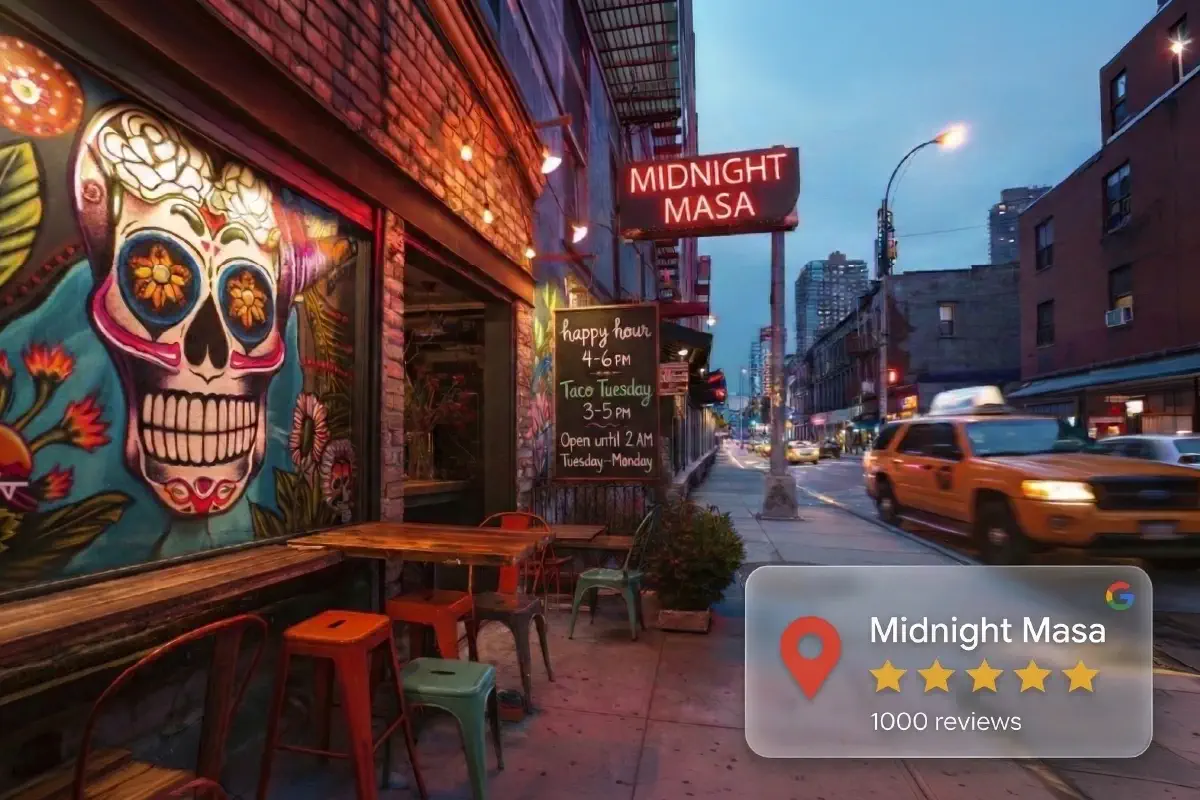
Search "tacos near me" in any mid-size American city. Look at the results. It's not Taco Bell sitting in the Local 3-Pack. It's the mom-and-pop taqueria with 847 Google reviews, authentic food photos that make your mouth water, and a Google Business Profile that looks like someone actually cares about it.
Now search "sushi near me" or "burgers near me" in the same city. The results are messier. Chains mixed with independents. Profiles with 6 blurry photos and no hours listed. Half the ordering links go to third-party delivery apps.
Taco restaurants are doing something different. And once you understand what it is, you can steal the entire playbook - whether you run a taco shop, a pizza place, a wing joint, or a fine-dining spot.
This is the pattern we're breaking down. For the full restaurant SEO framework, start with Restaurant SEO: The Complete Guide to Getting Found on Google. This article zooms in on why one restaurant category is winning and what Google is actually rewarding.
Before we get into the theory, let's talk about what "winning local search" actually looks like in dollars.
Taqueria El Tapatio is a taco restaurant in Santa Clarita, California. Not a chain. Not a franchise. An independent taco spot doing what independent taco spots do - making great food and trying to get the word out.
When they optimized their digital presence and made it easy for customers to find and order from them directly, they saw a +256% increase in revenue. Not a 25% bump. Not a "nice improvement." A near-quadrupling of their revenue.
That number isn't from a paid ad campaign with a $10,000 monthly budget. It came from getting their online ordering, Google Business Profile, and direct ordering channels dialed in with Chowly's platform. The customers were already searching for them. They just weren't finding them - or when they did, the revenue was going to third-party delivery commissions.
This is the story playing out at taco restaurants across the country. And it reveals a set of local SEO behaviors that happen to align perfectly with what Google rewards in 2026.
Here's the provocative take: independent taco restaurants accidentally optimize for Google's local search algorithm better than almost any other restaurant category.
It's not that taco shop owners are reading SEO blogs. It's that the cultural habits, operational patterns, and customer behavior around taco restaurants naturally produce the exact signals Google uses to rank local businesses.
Let's break down why.
Scroll through the Google Business Profile of a successful taqueria. The photos look real. A heaping plate of street tacos with grilled onions and cilantro. The salsa bar in all its neon-green glory. The abuela rolling tortillas. The line out the door on a Saturday.
These aren't shot by a photographer. They're taken by customers on their phones. And that's a big reason they work.
Google's algorithm values user-generated photos highly. When real customers upload real photos, it signals that people are actually going to this business, engaging with it, and caring enough to document the experience. A Google Business Profile with 200 authentic customer photos ranks higher than one with 20 professional stock-looking shots.
Taco restaurants generate this content organically. The food is photogenic. The experience is shareable. Customers post photos without being asked because a perfectly assembled al pastor taco is genuinely beautiful - and their friends need to see it.
What any restaurant can steal: Stop relying on one professional photo shoot per year. Encourage customers to take photos. Make your food presentation Instagram-worthy. Upload your own authentic, behind-the-scenes shots weekly. Google is watching photo engagement, freshness, and volume.
Here's a stat that should make every restaurant owner pay attention: taco restaurants often maintain higher review velocity than comparable restaurants in other categories.
Review velocity - how quickly you accumulate new reviews - is one of Google's strongest local ranking signals. It's not about having 1,000 total reviews. It's about getting 10 new ones this week, and 10 more next week, and 10 more the week after that.
Why do taco spots dominate this? A few reasons:
• High transaction volume at low price points - A taco restaurant serving $3 tacos sees more individual customers per day than a $50/plate steakhouse. More customers = more potential reviewers.
• Emotional food experiences - People feel strongly about their taco spot. It's personal. "My taco place" is a thing people say. That emotional connection drives unprompted reviews.
• Community gathering spots - Taquerias become neighborhood institutions. Regulars review them almost as an act of loyalty.
• Cultural word-of-mouth tradition - "You HAVE to try this place" is how taco restaurants grow. That same energy translates to online reviews.
The result: small taco restaurants routinely accumulate reviews at a pace that keeps them relevant in Google's freshness calculations, pushing them above competitors with stale review profiles.
What any restaurant can steal: Focus on review velocity, not just total reviews. Set a target of 5-10 new Google reviews per week. Ask at the peak moment - right after a compliment. Put QR codes linked to your Google review page on receipts, table tents, and takeout bags. For more review and ranking strategies, check out Local SEO for Restaurants: 15 Proven Strategies to Attract More Diners.
Here's where it gets technical - and where taco restaurants have a massive structural advantage.
When someone searches for food, they often search for specific dishes. "Birria tacos near me." "Al pastor tacos." "Breakfast burritos open now." These are long-tail keywords with high purchase intent. The person searching isn't browsing - they know what they want and they're ready to order.
Taco restaurant menus are naturally keyword-rich. Every menu item is a searchable term:
• Carne asada tacos
• Carnitas burrito
• Pozole
• Elote
• Churros
• Horchata
• Street tacos
• Fish tacos
• Birria ramen (yes, this is a thing, and it's a search monster)
Compare that to a burger restaurant where the menu items are "The Classic," "The Smokehouse," and "The BBQ Bacon." Those creative names are meaningless to Google. Nobody searches "the smokehouse burger near me."
Taco restaurants name their dishes what they are. And those dish names happen to be exactly what people type into Google.
What any restaurant can steal: Audit your menu for searchability. Do your item names match what people actually search for? "Wood-Fired Margherita Pizza" beats "The Margo" every time. Add specific dish names to your Google Business Profile menu, your website, and your Google Posts. For 17 more strategies like this, see 17 Restaurant SEO Tips That Actually Work in 2026.
Many successful taco restaurants keep their Google Business Profiles active without thinking of it as "SEO." They update hours for holidays. They post about new specials. They respond to reviews because it feels right, not because an algorithm told them to.
Google's local ranking algorithm heavily favors active, frequently updated profiles. A business that posts weekly, responds to reviews within 24 hours, and adds new photos regularly sends strong signals that it's a thriving, engaged operation.
The average independent taco restaurant is more likely to do this than the average independent restaurant in other categories. Why? Partly cultural - many taqueria owners are deeply connected to their communities and treat their Google profile like a community bulletin board. Partly operational - specials change frequently, seasonal ingredients rotate in and out, and there's always something to post about.
What any restaurant can steal: Treat your Google Business Profile like a social media channel. Post at least once a week - specials, behind-the-scenes content, team photos, events. Respond to every review. Update your hours for every holiday. Google rewards the restaurants that show up consistently. Check out Google: Your Restaurant's Digital Front Door for the complete breakdown.
Google's local algorithm cares deeply about geographic relevance. It's not just "are you close to the searcher?" - it's "are you meaningfully connected to this neighborhood?"
Taco restaurants excel here because they tend to become neighborhood landmarks. "The taco place on 5th and Main" becomes part of the local vocabulary. Customers mention the neighborhood in reviews. The restaurant references the neighborhood in their profile and posts.
This creates a web of geographic signals that Google uses to associate the business with specific local searches. When someone searches "best tacos in [neighborhood name]," the taqueria that's woven into the fabric of that community ranks highest.
What any restaurant can steal: Reference your neighborhood, cross streets, and local landmarks in your Google Business Profile description, Posts, and responses to reviews. "Thanks for visiting us here in the Arts District!" creates geographic relevance signals that help Google connect your business to location-specific searches.
Here's the thing about taco restaurants that's changed in the last two years. The smart ones aren't just getting found - they're capturing the order directly instead of routing it through a third-party delivery app.
Think about the math. If you're a taco spot doing 200 delivery orders a week at an average of $25 per order, and you're paying 25% commission to a delivery marketplace, that's $1,250 per week going to someone else. That's $65,000 a year.
Taqueria El Tapatio's +256% revenue increase didn't just come from getting more eyeballs. It came from converting those eyeballs into direct orders through their own ordering system, powered by Chowly's platform. When the Google Business Profile "Order" button sends customers to your own commission-free ordering system instead of a third-party app, you keep the full margin.
This matters more for taco restaurants than almost any other category because of those high transaction volumes we talked about. More orders at lower price points means the commission squeeze is especially brutal. When your average order is $18 and the delivery app takes $4.50 of that, your margin disappears.
What any restaurant can steal: Audit your Google Business Profile ordering links right now. If they point to a third-party delivery app, you're leaving money on the table with every single order. Replace them with your own direct ordering link. If you don't have a direct ordering system yet, that's the single highest-ROI investment you can make this year.
Let's pull back from taco restaurants specifically and talk about what this pattern reveals about Google's local search algorithm in 2026. These are the five signals that taco restaurants accidentally optimize for - and that any restaurant can intentionally optimize for:
Google tracks how many photos your profile has, how recently they were added, and how many were uploaded by customers vs. the business owner. Fresh, frequent, authentic photos signal a thriving business.
Target: 100+ total photos. Add 3-5 new ones every week. Encourage customer photo uploads.
Not just total reviews - the rate of new reviews and whether you respond to them. A 100% response rate within 24 hours is the gold standard.
Target: 5-10 new reviews per week. 100% response rate. Respond within 24 hours.
Every field filled out. Regular posts. Updated hours. Active Q&A. Google can see which profiles are actively managed and which were set up and forgotten.
Target: 100% profile completeness. 1-2 Google Posts per week. Q&A section populated with 5-10 entries.
Menu item names, review content, Q&A answers, Post text - Google pulls keywords from all of these to determine what you're relevant for. If your menu items match what people search for, you win.
Target: Menu items named for searchability. Posts mentioning specific dishes and cuisine types. Reviews that naturally include relevant keywords.
Clicks to call, clicks to website, clicks to order, direction requests - these engagement signals tell Google that your profile converts searchers into customers. Higher engagement = higher rankings.
Target: Clear CTAs on every post. Ordering link front and center. Phone number visible and clickable.
Whether you run a pizza place, a Thai restaurant, or a BBQ joint, here's how to implement the taco restaurant playbook in 30 days:
• Audit your Google Business Profile for completeness (every field, every attribute)
• Fix your ordering links - replace third-party delivery app links with your direct ordering URL
• Take 20+ new photos of food, interior, exterior, and team
• Rename and upload all photos with descriptive file names
• Create a Google review QR code and print it on receipts, table tents, and takeout bags
• Train your front-of-house team to ask for reviews at the peak moment
• Respond to every existing review you haven't responded to
• Set up a daily habit: respond to new reviews within 24 hours
• Seed your Q&A section with 7-10 common questions and answers
• Publish your first Google Post (weekly special, new item, or event)
• Add your full menu to your GBP with accurate item names and prices
• Post a behind-the-scenes video (30 seconds, shot on your phone)
• Publish 2 more Google Posts
• Add 5-10 more photos
• Review your GBP Insights - what searches are people finding you for?
• Adjust your strategy based on what's working
• Respond to reviews daily
• Post 1-2 times per week
• Add 2-3 new photos per week
• Ask happy customers for reviews (target: 5-10 per week)
The restaurant industry is going through a permanent shift. The days of relying on foot traffic and word-of-mouth alone are over. Google is where customers make decisions now. Not your website. Not social media. Google.
The taco restaurants winning local search aren't doing anything exotic. They're doing the basics consistently:
• Authentic content that reflects the real customer experience
• Active engagement with their community through reviews and posts
• Menu-first marketing that matches how people actually search
• Direct ordering capture that keeps the full margin
Chowly's AI-powered platform exists to make this entire playbook executable for any independent restaurant - not just the ones with a natural knack for it. From optimizing your Google Business Profile to turning search visibility into commission-free orders, it's the engine that lets you focus on cooking while the digital storefront runs itself.
Taqueria El Tapatio proved what's possible: +256% revenue from getting the digital side right. They didn't hire an SEO team. They didn't spend $5,000 a month on ads. They got their online presence dialed in, made it easy for customers to find and order directly, and let the results compound.
Your restaurant can do the same thing. Start with the 30-day plan above. The taco shops already figured out the formula. Now you just have to execute it.
• Taco restaurants are winning local search not by strategy, but by instinct - their natural operations produce exactly the signals Google rewards (authentic photos, review velocity, keyword-rich menus, active profiles)
• Taqueria El Tapatio proved the model: +256% revenue from optimizing their digital presence and capturing direct orders in Santa Clarita, CA
• Review velocity beats total review count - 10 new reviews per week matters more than 1,000 stale reviews. High-volume, low-price-point restaurants naturally generate more reviews per day
• Menu item names are SEO keywords - "carne asada tacos" matches real searches; "The Smokehouse" doesn't. Name your dishes what people search for
• Authentic photos outperform professional ones for Google rankings - 200 real customer photos beat 20 polished stock-looking shots every time
• Fix your ordering links first - if your Google "Order" button sends customers to a third-party app, you're paying 15-30% commission on orders that could be 100% yours
• Any restaurant can steal this playbook - follow the 30-day plan above to intentionally implement what taco restaurants do naturally
• Google is your real front door - the restaurants that treat their Google Business Profile like their most important storefront are the ones winning in 2026
Taco restaurants naturally produce the signals Google's local algorithm values most: high volumes of authentic customer photos, rapid review accumulation driven by high transaction counts and emotional food experiences, menu items that match long-tail search terms exactly, and active community engagement through their Google Business Profiles. It's not that Google favors tacos - it's that taco restaurant operations accidentally align with ranking factors better than most other restaurant categories.
Absolutely. The strategies taco restaurants use aren't cuisine-specific - they're behavior-specific. Any restaurant can encourage customer photos, build review velocity, name menu items for searchability, post weekly on Google, and capture direct orders. The key insight is that these behaviors should be intentional for your restaurant, even if they happen naturally for taco spots. A pizza restaurant, sushi bar, or BBQ joint that implements the 30-day plan in this article will see the same kind of results.
Reviews are arguably the single most impactful factor for local restaurant rankings. Google weighs three primary signals: relevance (does your profile match the search?), distance (are you close to the searcher?), and prominence (are you well-known and well-regarded?). Reviews are the dominant driver of prominence. Specifically, review velocity - how quickly you accumulate new reviews - matters more than total review count. A restaurant getting 10 new reviews per week will outrank one with more total reviews but no recent activity.
Check your ordering links. If your GBP "Order" button routes customers to a third-party delivery app instead of your own ordering system, you're losing 15-30% of every order in commissions and missing out on customer data you need for repeat marketing. Fix that first. Then tackle photos (aim for 100+), review velocity (5-10 new per week), and posting frequency (weekly minimum). These four actions - ordering links, photos, reviews, posts - cover roughly 80% of the ranking improvement most restaurants need.
Taqueria El Tapatio's growth came from the combination of increased search visibility (more people finding them on Google), direct order capture (orders flowing through their own system via Chowly instead of through commission-heavy third-party apps), and repeat customer engagement. The +256% figure represents total revenue growth, not just online orders. When you make it easier for customers to find you, order from you directly, and come back - the compounding effect on revenue is dramatic. They're a single-location independent taco restaurant in Santa Clarita, CA, which makes the result especially relevant for other independent operators.