If you're wondering how to get more Google reviews for your restaurant, it starts with understanding how restaurant Google reviews influence local search rankings.
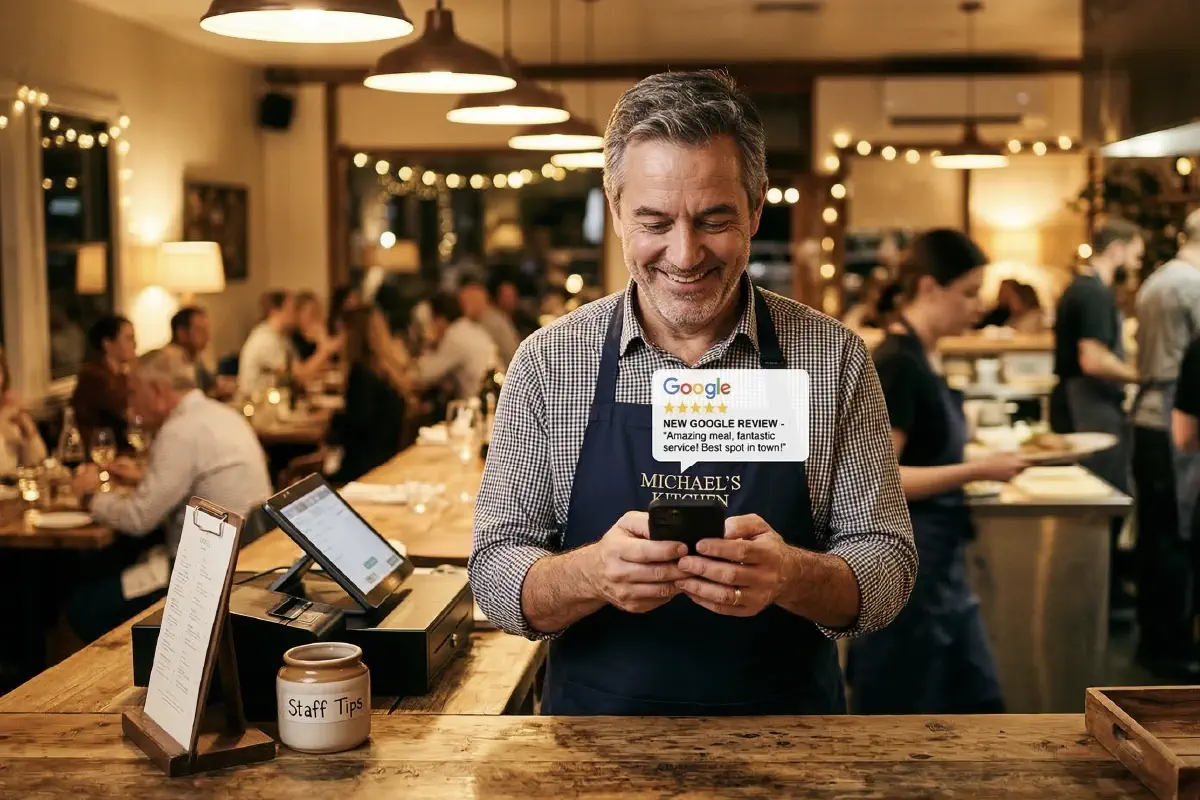
Reviews are one of the most important factors in Restaurant SEO.
Restaurant operators with higher Google review counts and ratings consistently appear in the top three results on Google Maps, also known as the "local 3-pack." According to a Harvard Business School study, each additional star on review platforms can increase revenue by 5 to 9 percent. For independent restaurants competing against chains with massive ad budgets, reviews are the most cost-effective ranking tool available.
This article explains how Google reviews influence restaurant rankings and outlines seven proven methods to generate more reviews.
Quick Answer: The fastest way to get more Google reviews for your restaurant is to ask at the moment of highest satisfaction, make leaving a review frictionless (QR codes or direct links), and respond to every review quickly. Restaurants that generate 3–5 new reviews per week tend to rank higher in Google Maps and local search results.
| Metric | Strong Benchmark |
|---|---|
| Google reviews | 100+ |
| Star rating | 4.2–4.8 |
| Review velocity | 3–5 per week |
| Review response time | under 48 hours |
Google's local search algorithm evaluates three primary review signals when deciding which restaurants appear in the local 3-pack: quantity, quality, and velocity. Together, these signals indicate popularity, trust, and ongoing customer activity.
Review quantity refers to the total number of reviews on your Google Business Profile. Restaurants with 100+ reviews consistently outrank those with fewer than 20, even when other factors like website quality are comparable. BrightLocal's 2025 Local Consumer Review Survey found that businesses in the top three map results averaged 47 more reviews than those ranked fourth through tenth.
Review quality means your average star rating. Google gives preference to businesses with 4.0 stars and above. A restaurant at 4.3 stars will typically outrank a nearby competitor at 3.7 stars, assuming similar review counts and relevance.
Review velocity measures how frequently new reviews arrive. A restaurant that receives five reviews per week signals ongoing relevance to Google. A restaurant with 200 reviews but none in the past six months sends the opposite signal: that the business may be declining or inactive.
• Quantity | What Google Measures: Total review count on GBP | Target: 100+ reviews minimum
• Quality | What Google Measures: Average star rating | Target: 4.0 stars or higher
• Velocity | What Google Measures: New reviews per week | Target: 3-5+ new reviews weekly
• Recency | What Google Measures: Age of most recent review | Target: Within last 7 days
• Keywords | What Google Measures: Menu items and cuisine mentioned in reviews | Target: Natural keyword mentions
Simple review goal: A restaurant serving 1,000 customers per week only needs about 0.3% of guests to leave a review to generate 3 new reviews per week.
Google extracts keywords from review text and uses them as ranking signals, which is why Google reviews for restaurants play such a powerful role in local SEO. When a customer writes "best fish tacos in Austin," Google associates your restaurant with the search query "best fish tacos in Austin." This is free keyword targeting that no amount of paid advertising can replicate.
Restaurants whose reviews naturally include cuisine types, dish names, and location references rank significantly better for "best [food] near me" searches. A BrightLocal analysis found that restaurants with keyword-rich reviews were 2.3 times more likely to appear in the local 3-pack for relevant food searches.
💡 Operator Action Item: When asking for reviews, suggest customers mention what they ordered. "We'd love a Google review, especially if you enjoyed the brisket." This subtle prompt increases the chance of keyword-rich reviews without violating Google's review policies.
Ranking in the local 3-pack matters, but your star rating determines whether searchers actually click on your listing. Google's own data shows that businesses with ratings below 4.0 stars receive 70 percent fewer clicks than those rated 4.0 and above.
The sweet spot for restaurants is between 4.2 and 4.8 stars. Many operators looking to improve their Google rating for a restaurant focus on generating more positive reviews and responding quickly to customer feedback. Ratings of 5.0 actually generate suspicion among consumers, with 52 percent of shoppers saying a perfect rating makes them question whether the reviews are legitimate.
KPI Benchmarks for Restaurant Google Reviews:
• Minimum viable rating: 4.0 stars (below this, visibility drops significantly)
• Optimal rating: 4.2 to 4.8 stars
• Click-through advantage: 4.5-star restaurants get 28% more clicks than 3.5-star restaurants
• Review response impact: Responding to reviews increases rating by an average of 0.12 stars over 6 months
Getting reviews consistently requires a system, not a one-time ask. Restaurants that actively get restaurant reviews each week outperform competitors that rely on occasional feedback.
The 7 most effective ways to get more Google reviews:
• Post-order survey routing
• QR codes at the register and receipts
• Staff asking after positive feedback
• SMS/email review follow-ups
• Responding to every review
• Featuring reviews in marketing
• Setting monthly review goals
The most effective review generation method intercepts customer feedback at the moment of highest satisfaction. Smart survey systems send a brief satisfaction check after each order. Customers who rate their experience 5 stars are automatically redirected to your Google Business Profile review page. Customers who rate 1 through 4 stars are routed to a private feedback form instead.
This approach accomplishes two things simultaneously: it generates a steady stream of positive Google reviews and it catches negative experiences before they become public 1-star reviews. The Chowly Platform includes a customer survey tool, which replaces standalone tools like Ovation (typically $100/month).
See how Taqueria El Tapatio grew visibility by 256% with a complete SEO and review strategy
Physical QR codes that link directly to your Google review page convert 3 to 5 percent of in-store customers into reviewers. Place them at the register, on table tents, and on printed receipts. The key is reducing friction: one scan, straight to the review form, no searching required.
Pro tip: Generate a direct Google review link from your Google Business Profile dashboard and use it in QR codes, receipts, and SMS messages. Removing the search step dramatically increases review conversion rates.
The ideal time to request a review is immediately after a compliment. When a customer says "that was amazing," staff should respond with: "That means a lot. If you have 30 seconds, a Google review would really help us out." This specific, time-bounded request converts at 2 to 3 times the rate of generic "leave us a review" signs.
Online ordering customers are already comfortable with digital interactions. A follow-up message 30 to 60 minutes after delivery with a direct link to your Google review page captures reviews from customers who might never think to leave one on their own.
Google has confirmed that responding to reviews is a ranking factor. Businesses that respond to reviews are seen as more engaged and trustworthy, which influences both ranking and click-through behavior. Respond to every review within 24 to 48 hours.
For negative reviews, acknowledge the concern and offer to resolve it offline. A professional response to a negative review can actually increase trust among future customers reading your reviews.
Displaying Google reviews on your website, social media, and in-store signage creates a feedback loop. When customers see that you value and share reviews, they become more likely to leave their own. It also reinforces social proof for new customers discovering your restaurant.
Set a specific monthly target (example: 20 new reviews) and track progress weekly. Share the count with your team. Restaurants that set explicit review goals generate 40 to 60 percent more reviews than those that rely on organic review growth alone.
Many restaurants unintentionally slow their review growth by making a few common mistakes:
| Review Signal | What Google Measures | Target Benchmark |
|---|---|---|
| Quantity | Total review count on GBP | 100+ reviews minimum |
| Quality | Average star rating | 4.0 stars or higher |
| Velocity | New reviews per week | 3-5+ new reviews weekly |
| Recency | Age of most recent review | Within last 7 days |
| Keywords | Menu items and cuisine mentioned in reviews | Natural keyword mentions |
Google's algorithm rewards consistent review activity, not occasional bursts.
Reviews work hardest when your Google Business Profile is fully optimized as part of a broader restaurant reputation management strategy. An incomplete profile with strong reviews still underperforms a complete profile with moderate reviews. Key GBP optimization factors that work alongside reviews include:
• Accurate business hours updated for holidays and special events
• High-quality photos uploaded weekly (businesses with 100+ photos receive 520% more calls, per Google)
• Regular Google Posts sharing menu updates, specials, and events
• Complete Q&A section with answers to common questions
• Correct categories and attributes matching your cuisine and service types
The Chowly Platform includes Google Business Profile management that handles all of these elements, ensuring your reviews land on an optimized profile that maximizes their ranking impact.
Learn how Fan Tang achieved a 17x return on ad spend with a complete digital presence strategy
AI search tools like ChatGPT, Google Gemini, and Perplexity pull restaurant recommendations from structured web data, and Google reviews are a primary data source. When someone asks an AI assistant "best Italian restaurant in Denver," the AI weighs Google review ratings, review count, and review content in its response.
Restaurants with strong review profiles are already appearing in AI-generated recommendations. Mr. Chicken, a Chowly Platform customer, achieved the number-one AI search result within one week of launch, partly due to strong review signals combined with an optimized web presence.
This means your review strategy today directly affects your visibility in both traditional Google search and the rapidly growing AI search channel.
Explore the full Restaurant SEO guide
• Google weighs review quantity, quality, and velocity when ranking restaurants in local search and Maps results
• Each additional star rating can increase restaurant revenue by 5 to 9 percent (Harvard Business School)
• Reviews that mention specific menu items and location terms boost keyword rankings for "best [food] near me" searches
• The optimal star rating range is 4.2 to 4.8, as perfect 5.0 ratings generate consumer suspicion
• Post-order survey routing is the most effective automated review generation method - like the system built into the Chowly Platform
• Responding to every review within 48 hours is a confirmed Google ranking factor
• AI search tools pull from Google review data, making your review strategy critical for future visibility
• Systems like post-order survey routing are one of the most effective ways to increase restaurant Google reviews consistently
Ready to build a review and SEO strategy that puts your restaurant in the local 3-pack? Get a demo of the Chowly Platform and see how automated survey routing, GBP management, and AI-optimized web presence work together to increase visibility, SEO performance, and online orders.
There is no fixed minimum, but restaurants with 100 or more reviews have a significant advantage. BrightLocal data shows that businesses in the top three Google Maps results average 47 more reviews than those ranked below. Focus on consistent weekly review generation rather than a one-time push.
A small number of negative reviews (under 10 percent of total) do not hurt rankings and can actually increase credibility. Google's algorithm considers overall rating and review volume more heavily than individual negative reviews. The bigger risk is leaving negative reviews unanswered, which signals disengagement.
Yes. Google allows businesses to request reviews and even provides a direct review link through your Google Business Profile dashboard. You cannot offer incentives (discounts, free items) in exchange for reviews, and you cannot ask for specifically positive reviews. Simply ask customers to share their honest experience. This is a common tactic in restaurant reputation management, as long as the request asks for an honest review rather than specifically positive feedback.
New reviews typically influence rankings within one to two weeks. Google crawls and processes review data regularly, and a sudden increase in review velocity sends a strong positive signal. Consistent weekly reviews have a compounding effect on rankings over time.
Yes. Google has indicated that responding to reviews signals engagement and can influence local search visibility. Responding also increases the likelihood of future reviews by 12 percent, according to a Harvard Business Review study. Keep responses brief, professional, and personalized.